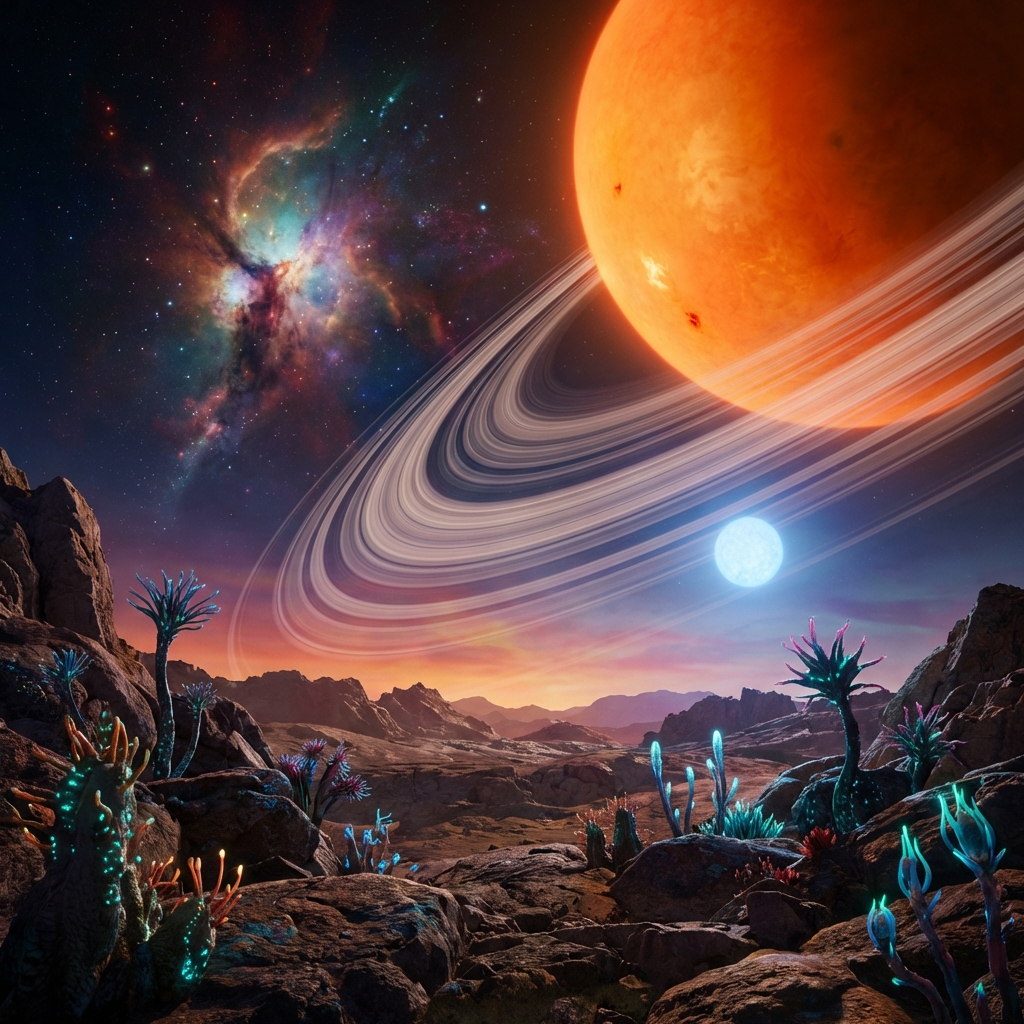
Until 1992, we didn't know for certain if any stars other than our Sun had planets. Today, we have confirmed the existence of over 5,000 exoplanets, with billions more likely to exist in the Milky Way alone. We are no longer asking *if* other worlds exist, but if any of them are home to life.
The Goldilocks Zone
Astronomers primarily look for planets in the "Habitable Zone" or "Goldilocks Zone"—the region around a star where temperatures are just right for liquid water to exist on a planet's surface. Water is the universal solvent for life as we know it, making these worlds the prime candidates for our search.
Hunting for Biosignatures
With the James Webb Space Telescope (JWST), we are now able to "see" the atmospheres of these distant worlds. By analyzing the light filtering through the atmosphere (transmission spectroscopy), we can detect gases like oxygen, methane, and carbon dioxide. If we find a planet with an atmosphere rich in both methane and oxygen, it could be a "smoking gun" for biological activity.
The Fermi Paradox
If the galaxy is teeming with planets, where is everybody? This is the Fermi Paradox. Solutions range from the "Great Filter" (the idea that intelligent life inevitably destroys itself) to the possibility that we are simply the first to arrive on the scene.
Conclusion
The search for exoplanets is more than a scientific endeavor; it is a search for our context in the universe. Whether we find a vibrant alien biosphere or a silent cosmos, the answer will forever change how we view our Pale Blue Dot.