In the popular imagination, the brain is often likened to a computer. We speak of "processing" information, "retrieving" memories, and "uploading" knowledge. While the metaphor is convenient, it is fundamentally flawed—and the rise of Artificial Intelligence has brought into sharp relief just how different biological intelligence is from its digital counterpart.
As an AI researcher who has spent the last decade working with neural networks, I've come to appreciate that comparing AI to human intelligence is like comparing a freight train to a falcon. Both move things from place to place, but they operate on entirely different principles, with different strengths, weaknesses, and fundamental limitations. In this article, we'll explore the architectural differences between biological and artificial intelligence, examine what each does best, and consider what the future of human-AI collaboration might look like.
1. The Energy Efficiency Paradox: 20 Watts vs. Megawatts
The human brain is an engineering marvel that makes every supercomputer look like an energy-guzzling brute. It runs on approximately 20 watts of power—roughly the amount needed to power a dim lightbulb or charge a smartphone. With this meager energy budget, it manages perception, motor control, memory, emotion, language, abstract reasoning, and consciousness, all continuously and in parallel.
In contrast, training a state-of-the-art Large Language Model like GPT-4 requires an estimated 50-100 gigawatt-hours of electricity—enough to power a small town for months. The training process consumed thousands of high-end GPUs running continuously for months. Even running inference (generating text) on these models requires massive server farms. A single ChatGPT query uses approximately 10-50 times more energy than a Google search.
Key Insight: The brain achieves this efficiency through analog computation, sparse activation (only 1-4% of neurons fire at any moment), and three-dimensional integration. Silicon chips are digital, dense, and two-dimensional—fundamentally different architectures.
This efficiency gap isn't just an engineering challenge—it reveals a fundamental difference in approach. The brain doesn't brute-force problems; it uses heuristics, context, and "good enough" approximations to save energy. It predicts what will happen next rather than calculating everything from scratch. This predictive processing, known as the free energy principle, allows the brain to minimize surprise and energy expenditure simultaneously.
2. Architecture: Von Neumann vs. Neuromorphic
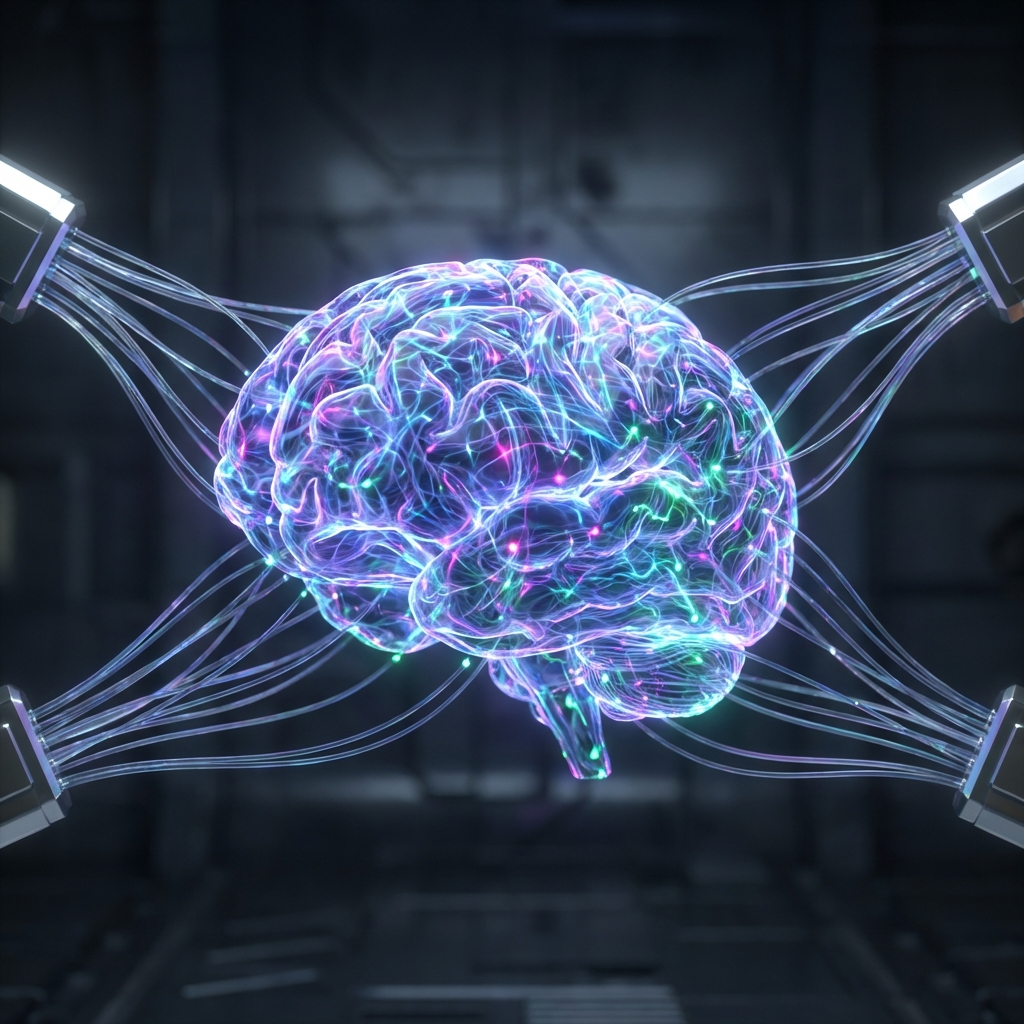
Digital computers are von Neumann machines: they rigidly separate processing (the CPU) from memory (RAM). Data must travel back and forth between them through a bottleneck known as the von Neumann bottleneck. This architecture, while excellent for precise calculations, is fundamentally inefficient for the kind of pattern recognition brains excel at.
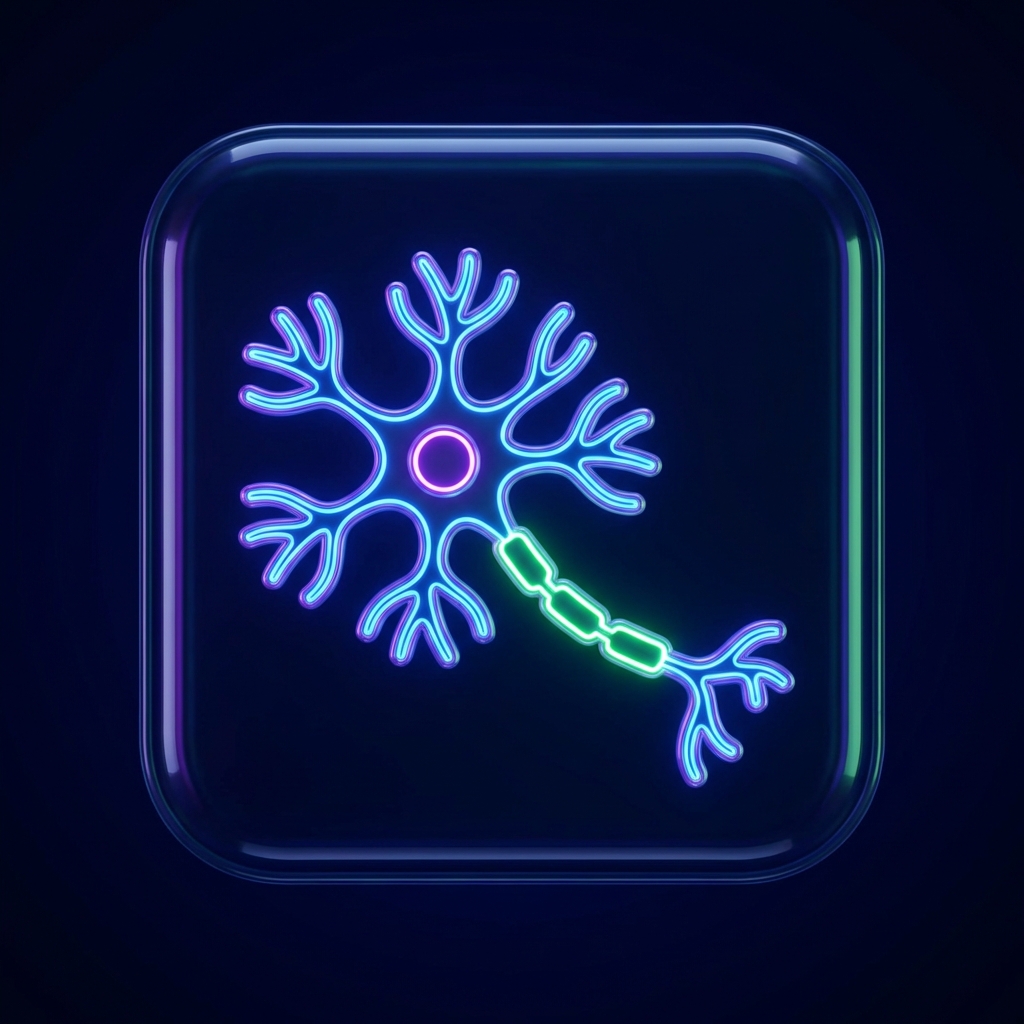
The brain, by contrast, is a neuromorphic architecture. Memory and processing are co-located in every single synapse. A synapse—the connection between neurons—is simultaneously a storage device (it stores connection strength) and a processing unit (it modulates signal transmission). When you learn a new skill, you aren't writing data to a hard drive; you are physically rewiring the hardware itself, strengthening some connections and weakening others.
This "plasticity" allows the brain to adapt to injury or new environments in ways silicon cannot yet match. Stroke victims can reassign functions to healthy brain regions. London taxi drivers develop larger hippocampi from memorizing the city's complex street layout. Musicians show enhanced auditory cortex development. The brain is not just a computer—it's a computer that constantly rebuilds itself based on experience.
3. Learning: Statistical Correlation vs. Conceptual Understanding
Show a toddler a picture of a "cat" three or four times, and they will recognize cats for the rest of their life. They can identify a cartoon cat, a sleeping cat, a tailless cat, or even a cat costume on a dog. They understand that cats are living things that eat, sleep, and purr. This is few-shot learning with deep conceptual understanding.
AI models require terabytes of data—trillions of words and millions of images—to achieve similar recognition capabilities. They learn by statistical correlation, not by understanding the underlying "concept" of a cat. An AI has seen millions of cat photos but doesn't know that cats are mammals, that they have hearts and brains, or that they evolved from wild predators. It recognizes patterns of pixels, not the essence of cathood.
This limitation becomes apparent in edge cases. If an AI sees a cat in a context it hasn't encountered in its training data—for example, a cat texture mapped onto a teapot—it may fail spectacularly where a human would not. Humans can generalize from limited examples because we build causal models of the world. AI generalizes by finding statistical patterns, which breaks down when the statistics change.
4. The Black Box Problem: Interpretability vs. Performance
Ironically, while we built AI, we don't fully understand it. Deep neural networks are often "black boxes"—we know the input and the output, but the internal logic is a dense matrix of billions of floating-point numbers that is essentially unreadable to humans. We can see that the model works, but we struggle to explain why it makes specific decisions.
This creates serious problems for high-stakes applications. If an AI denies your loan application, you have a right to know why. If a medical AI recommends treatment, doctors need to understand its reasoning. Current interpretability research—techniques like attention visualization and feature attribution—provides glimpses into the black box, but nowhere near the level of understanding we have of human decision-making.
Interestingly, neuroscience faces a similar challenge with the brain. We have mapped the brain's regions and know which areas activate during different tasks, but we still struggle to explain consciousness—how subjective experience emerges from physical processes. We know where pain happens, but not how the feeling of pain arises. Both AI and the brain present us with systems that work but resist easy explanation.
5. What AI Does Better: Pattern Recognition at Scale
Despite these limitations, AI excels at tasks where scale and consistency matter. It can analyze millions of medical images to detect patterns invisible to human radiologists. It can process decades of weather data to predict storms. It can translate between hundreds of languages instantly. It can play chess and Go at superhuman levels by evaluating millions of positions per second.
AI doesn't get tired, distracted, or emotional. It doesn't have bad days or make careless mistakes due to fatigue. It can maintain consistent performance on repetitive tasks that would bore humans to error. In narrow, well-defined domains with abundant data, AI often surpasses human performance. The key is recognizing that these are complementary strengths, not competing ones.
6. The Path Forward: Collaboration, Not Replacement
The fear that AI will replace human intelligence overlooks the fundamental differences in our natures. AI excels at pattern matching, large-scale data analysis, and repetitive tasks. Humans excel at creativity, adaptability, empathy, moral reasoning, and judgment in novel situations. We are not competitors—we are partners with different strengths.
The future isn't AI versus Human; it's AI plus Human. By offloading energy-intensive computation to machines, we free up our biological 20 watts for what they do best: dreaming, inventing, empathizing, and understanding the "why" behind the data. The radiologist who uses AI to catch tumors they might have missed. The scientist who uses AI to analyze data and generate hypotheses to test. The writer who uses AI to research and outline, then adds the human touch.
As we build increasingly powerful AI systems, we must remember that efficiency isn't everything. The brain's 20 watts doesn't just compute—it creates poetry, falls in love, questions its own existence, and dreams of the future. These are not bugs to be optimized away but features that make us human. The goal isn't to build artificial humans but to build tools that amplify what makes us uniquely human.
Conclusion: Two Architectures, One Future
The comparison between silicon and synapse reveals that intelligence is not a single thing but a spectrum of capabilities. Biological evolution optimized for energy efficiency, adaptability, and survival in an unpredictable world. Human engineering optimized for precision, scalability, and consistency. Both approaches have their place.
As an AI researcher, I'm often asked when machines will surpass humans. The answer is: they already have, in specific domains. But the more interesting question is when humans and machines working together will achieve what neither could alone. That future is already here—we just need to design systems that leverage the complementary strengths of both architectures.
The brain remains the most efficient, adaptable, and mysterious intelligence we know. Rather than trying to replicate it exactly, we should learn from its principles while building tools that extend our capabilities. The 20-watt supercomputer in your skull deserves a silicon companion that amplifies its strengths without replacing its essence. That is the future worth building.
About This Analysis
This article draws on my decade of experience in AI research at Google DeepMind and current work in neuromorphic computing. The comparisons between biological and artificial intelligence are based on peer-reviewed research in computational neuroscience and machine learning. While the field evolves rapidly, the fundamental architectural differences between silicon and biological computing are likely to persist for the foreseeable future.