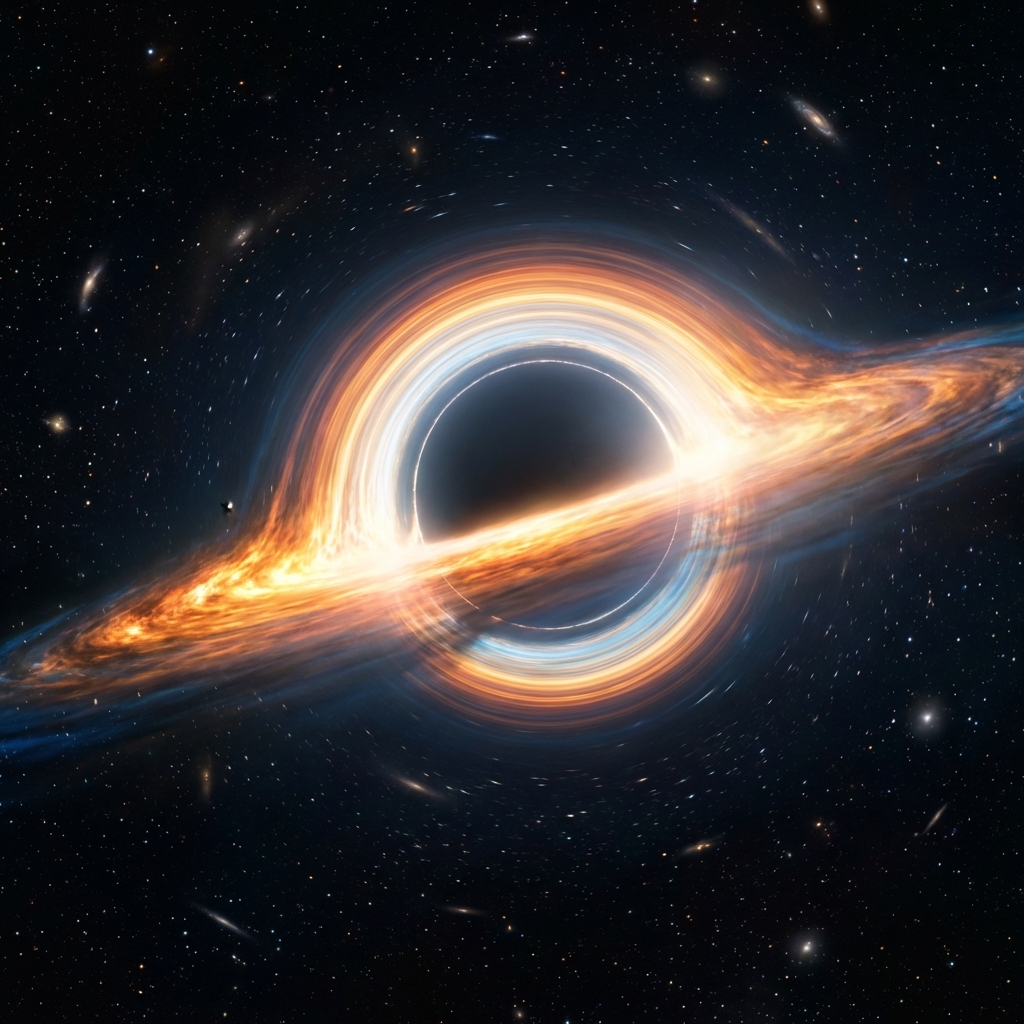
Black holes are the bogeymen of the cosmos. They are regions of space where gravity is so strong that nothing—no particles or even electromagnetic radiation such as light—can escape from it. The theory of general relativity predicts that a sufficiently compact mass can deform spacetime to form a black hole.
The Event Horizon
The boundary of the region from which no escape is possible is called the event horizon. Although the event horizon has an enormous effect on the fate and circumstances of an object crossing it, it has no locally detectable features according to general relativity. In many ways, it acts as a point of no return.
If you were to fall into a black hole, you might experience "spaghettification," a process where the difference in gravitational pull between your head and your feet is so extreme that you are stretched out like a noodle.
The Singularity
At the center of a black hole lies the singularity, a point of infinite density and zero volume. Here, the laws of physics as we know them cease to function. It is a place where space and time merge and break down.
Physicists have struggled to reconcile the physics of the singularity (General Relativity) with the physics of particles (Quantum Mechanics). This conflict is one of the biggest unsolved problems in physics, leading to the search for a "Theory of Everything."
Hawking Radiation
In 1974, Stephen Hawking proposed that black holes are not entirely black. He theorized that they emit small amounts of thermal radiation due to quantum effects near the event horizon. This usually implies that black holes can slowly lose mass and energy over time, eventually evaporating completely.
- Information Paradox: If a black hole evaporates, what happens to the information about the stuff that fell in? Quantum mechanics says information cannot be destroyed.
- Micro Black Holes: Some theories suggest tiny black holes could be created in particle accelerators, though they would evaporate instantly.
Imaging the Unseen
In 2019, humanity captured the first-ever image of a black hole's shadow in the galaxy M87 using the Event Horizon Telescope. This monumental achievement confirmed many of Einstein's predictions and gave us visual proof of these cosmic monsters.
Conclusion
Black holes remain the ultimate laboratory for extreme physics. They challenge our imagination and force us to question the very fabric of reality. As we continue to study gravitational waves and image more of these objects, we may finally unlock the secrets hiding behind the event horizon.